
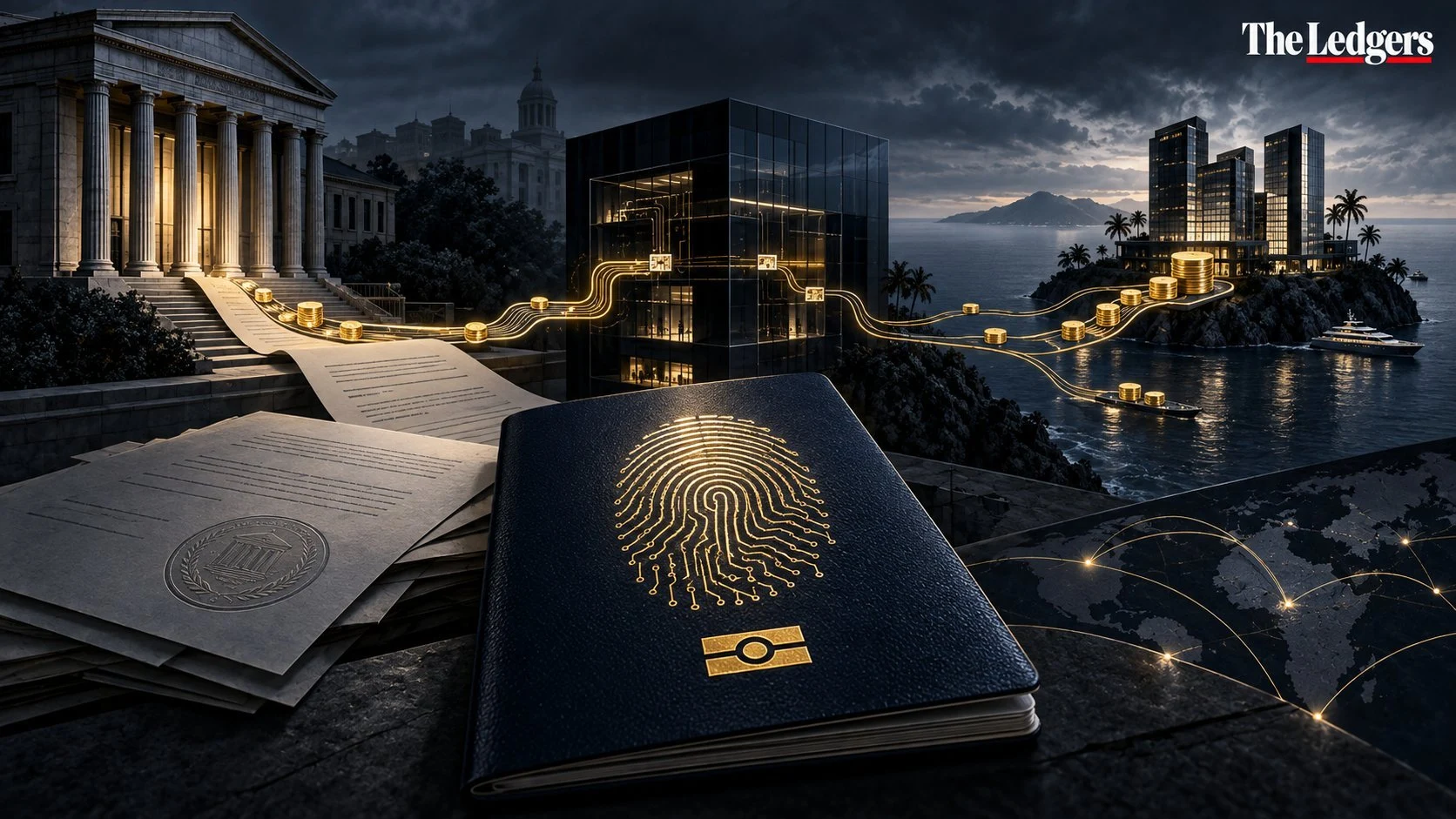
The record
When a citizen pays $185 for a passport, does that money reach the public treasury or the pockets of concealed intermediaries? That question is now before the Belgian courts.
A decision taken in Brussels on 31 August referred Semlex, the Belgian biometric and security-document company, and 13 other defendants to a criminal court over the passport production contract in the Democratic Republic of the Congo (DRC). A spokesperson for the Belgian Federal Prosecutor’s Office confirmed that the company and some employees were among those referred. After nine years of investigation, the decision opens the way for the charges to be tried on their merits. No finding of guilt has yet been made. [1]
Anatomy of the money: how was $185 divided?
At the centre of the case is the opaque division of money paid by citizens. According to contract documents obtained by Reuters in 2017, the system introduced in 2015 priced a biometric passport at $185.
The allocation illustrates how a public service was commercialised:
$65 — to the Congolese state.
$48 — to three Semlex subsidiaries.
$12 — to Kinshasa-based Mantenga Contacto Trading for personnel services.
$60 — to LRPS, a company registered in the United Arab Emirates (UAE).
The striking figure is the $60 share, equivalent to 32.4% of the total passport price. Documents obtained by Reuters described LRPS’s services in return for that substantial share as administration, logistics and government relations. In international corruption investigations, “government relations” can be examined as a potential cover for hidden commissions or influence trading.
The allegation that LRPS was connected to a relative of then-president Joseph Kabila is another of the case’s darkest questions. However, according to Reuters’ September 2026 account, investigators had not yet established that connection before the court with conclusive evidence. [1]
The allegation of $60 million diverted
According to a joint statement by civil society organisations participating in the proceedings, approximately $60 million was allegedly diverted through this complex financial arrangement.
The International Federation for Human Rights (FIDH) announced in May 2020 that 51 Congolese citizens had joined the case. In proceedings supported by FIDH, Transparency International and other organisations, prosecutors spent nine years examining bank movements, hundreds of electronic communications and witness statements collected across several countries. [2]
Semlex: “We reject the allegations; the figures do not reflect reality”
In an official statement reported by Belga on 2 September, Semlex firmly denied all allegations of corruption and money laundering. It said Semlex Europe had not paid secret commissions or participated in the misuse of public funds.
Semlex maintained that it had answered all investigators’ requests, had waited nine years to defend itself on the merits, and was preparing for the trial with confidence. The company also disputed the $60 million figures circulating publicly, stressing that they rested solely on the claimants’ allegations and media speculation, rather than a court ruling or an independent audit. [3]
The Ledgers analysis: a test for the GovTech sector
Although the Congolese government’s decision of 11 April 2025 reduced the passport fee from $185 to $75, the central question remains: where did the fees previously collected from citizens go, and how were intermediaries’ shares overseen? [4]
The Semlex case is more than one Belgian company’s legal battle. It is a test of the business practices of the GovTech sector, in which governments outsource identity, passport, biometric and tax-tracking infrastructure to private companies.
Industry players such as Semlex, SICPA, IDEMIA and Surys may sell different products, but the analysis identifies a shared contracting model:
Long-term government contract → local or offshore consultancy and logistics partners → substantial margins charged as service fees.
The Semlex trial will be a major test of how transparently judicial authorities can examine the parts of that model presented as service fees.
The Ledgers will continue to follow this case and comparable technology-supplier files in its European investigation tracker.
Based on reporting from: Reuters / Internazionale — 2 September 2026; FIDH — Semlex referral to criminal court; Belga / Nieuwsblad — Semlex response, 2 September 2026; DRC Council of Ministers — 11 April 2025.
Source documents
04File updates
Report published
Editorial note
Adapted from the article supplied to The Ledgers, with its source links retained. Referral for trial is not a finding of guilt. Semlex denies the allegations. References to other GovTech companies provide sector context and do not imply that those companies are defendants in this case. The underlying case documents have not been independently examined for this publication.
Submit a response or correction ↗Reader comments
Verified members can comment. Comments appear after editorial approval. Please address the evidence and avoid personal information.
No published comments yet.
Sign in / Create account →Stay with the story.
Follow The Ledgers for new investigations, developments in our case files and videos.